
Scientifically grounded. Technologically ready.
Scientifically grounded. Technologically ready.
We rely on in-depth research and strong partners to accelerate the market ramp-up of synthetic fuels.

True innovation happens where passion meets responsibility
Our R&D activities aim to systematically translate scientific findings into marketable, regulatory-compliant, and scalable solutions.
DeCarTrans
Joint project for the development and market launch of renewable fuels
The eFUEL GROUP contributes industry- and application-oriented perspectives to the DeCarTrans project. The focus is on evaluating real-world application scenarios for synthetic fuels, system integration, and the derivation of marketable implementation models.
The joint project aims to promote the development of renewable fuels such as eFuel 95 E10, eFuel 98 E10, and eFuel 102 E10 to reduce new CO₂ emissions in the transport sector. The fuel used is based on the methanol-to-gasoline process developed by CAC ENGINEERING and is produced at the TU Bergakademie Freiberg in the world's largest* demonstration plant for research and development purposes.
* As of: September 2026
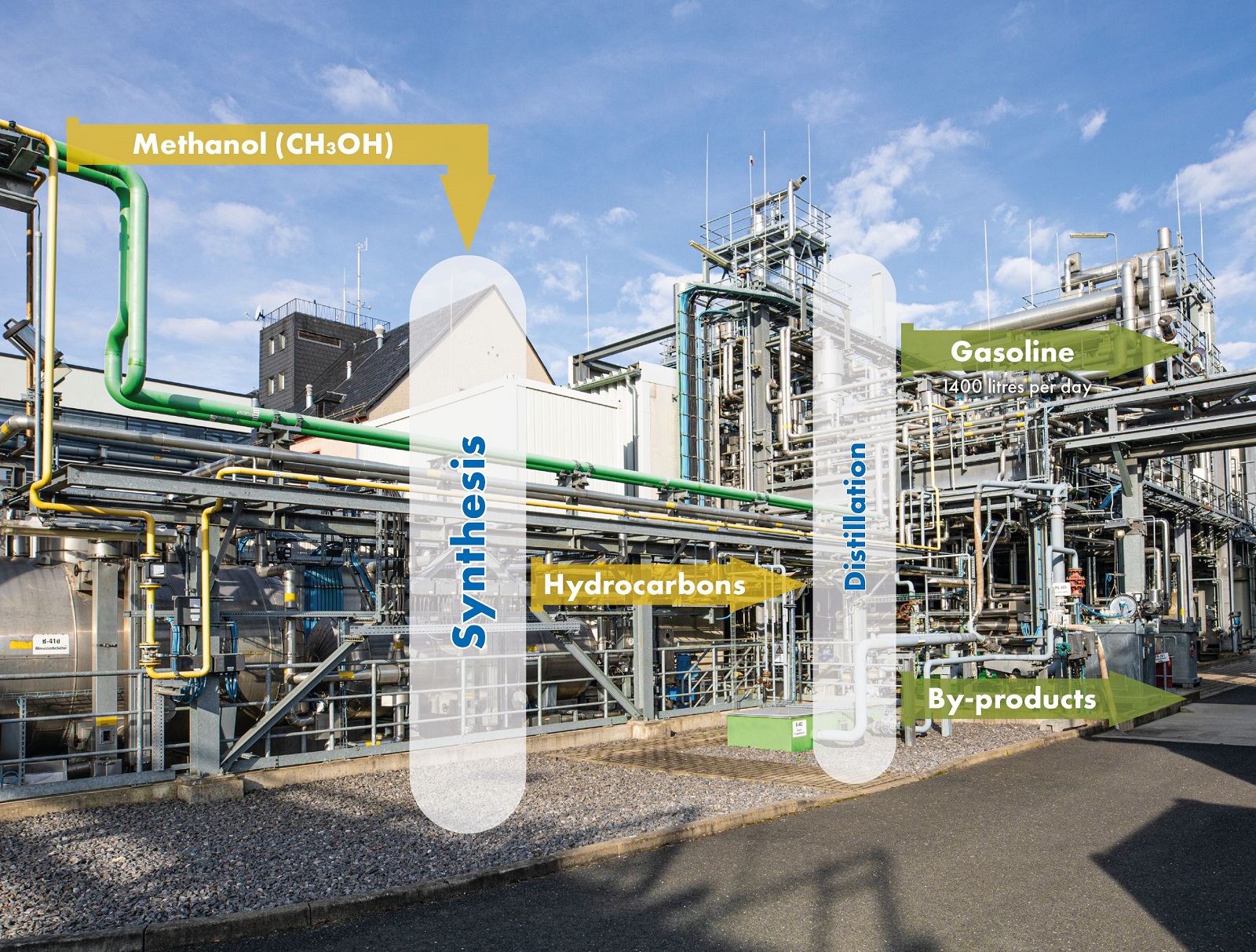
© TUBAF
** According to the test report from the independent testing laboratory Intertek (Switzerland), a value of more than 90% was determined as part of a C14 isotope analysis.
.jpg)
Focus: Decarbonization pathways in the transport sector
The DeCarTrans project is funded by the Federal Ministry for Digital and Transport as part of the overall concept for renewable fuels, with a total of 14.93 million euros. The funding guidelines for the development of renewable fuels are coordinated by NOW GmbH and implemented by the project management agencies VDI/VDE Innovation + Technik GmbH and the Agency for Renewable Resources (FNR).
Further information is available at: https://www.decartrans.de/
PEGASUS
A lighthouse project for Hamburg
The center's first major project is PEGASUS, a joint initiative by DACMA GmbH, Lother GmbH, and the Hamburg University of Technology. This collaboration pools expertise from engineering, science, and industry to accelerate the commercialization and integration of DAC technologies into existing port infrastructure.
As part of PEGASUS, the eFUEL GROUP supports the transition of new fuel and system concepts to higher Technology Readiness Levels (TRL) and actively contributes to bridging the gap between research, regulation, and industrial application.
Focus: Advanced fuel systems and cross-sector applications

Four steps to producing eFuels
The path from CO₂ to fuel is clear and proven. Every step brings us closer to true sustainability.
Carbon dioxide from the air
We capture CO₂ directly from the atmosphere and use it as a raw material.
Hydrogen via electrolysis
Green electricity splits water into hydrogen and oxygen.
Synthesis into liquid fuel
CO₂ and hydrogen combine to form stable hydrocarbons.
Use in existing vehicles
Finished eFuel fits into any tank without modifications.
eFuels versus the alternatives
Three paths to clean mobility in direct comparison.

FAQ
Answers to the most important questions about eFuels and our technology.
eFuel has an indefinite shelf life when stored correctly. It is no different from conventional fuel in terms of stability and can be used in existing tanks and lines without the need for special conditions.
Yes. Any vehicle with an internal combustion engine can use eFuel. It is fully compatible with existing engines, pumps, and tank systems. No modifications or retrofitting are required.
The process begins with the direct air capture of CO₂. Green electricity splits water into hydrogen. CO₂ and hydrogen are then combined in a synthesis process to create liquid fuel.
Yes, provided the electricity comes from renewable sources. The CO₂ released during combustion was previously captured from the atmosphere. The cycle is closed and neutral.
Initial commercial production facilities are already in the planning and construction phase. Availability will increase gradually over the coming years, depending on investment and regulatory support.
Still have questions?
We are happy to help and answer all your questions.